

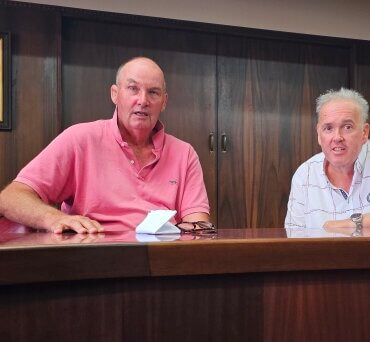
Inside the old board room at Te Rapa Racecourse, racing club chair Bruce Harvey, left, and chief executive Andrew Castles
Dairy land tagged for mega racing hub
Waikato Thoroughbred Racing has secured a conditional deal to buy 150 hectares south of Hamilton, marking the first major step toward relocating and modernising the region’s thoroughbred racing operations.

Inside the old board room at Te Rapa Racecourse, racing club chair Bruce Harvey, left, and chief executive Andrew Castles have planned the purchase for months. Photo: Mary Anne Gill

Andrew ‘Butch’ Castles
Chief executive Andrew Castles told The News the deal follows a year-long search for prime Waikato land. He said it was a once-in-a-century opportunity to reshape the industry.
The “super club,” formed in 2023 through the merger of Waikato Racing, Cambridge Jockey and Waipā Racing clubs, has chosen a dairy farm site bordering the Waikato Expressway to the north and the Te Awa River Ride to the south, with Pencarrow and Duncan roads on either side.
“If you asked me where the optimum site would be for a 100 year build to secure the future of thoroughbred racing in the Waikato, I doubt you could find a better site,” said Castles.
The club’s due diligence included aerial surveys, environmental assessments and infrastructure analysis – Castles even flew over the property by helicopter.

The location of the new greenfield site.
The current landowners will continue dairy operations until contractual dates are met, beginning with the 2027 dairy season.
Environmental studies are underway and, led by BCD Group, will cover water supply, wildlife, roading and electricity demand.
One of the key drivers behind the move is growing pressure on the Cambridge training centre, where housing intensification and traffic congestion are making daily training more difficult. To fund the new site, the club would sell its existing land in Hamilton, Te Awamutu and Cambridge.
The proposed development would replace Te Rapa’s ageing infrastructure. Plans include flexible event spaces, equine rehabilitation and veterinary facilities, and capacity for up to 1500 horses. The scale of the site also allows for future projects such as a national sales centre.
“Gone are the days of the grandiose grandstand. It will be a modern, multi‑purpose facility that can double as an event centre,” said Castles.

Cyclists ride along the Te Awa River Ride in Hooker Road, the southern boundary of the site. Photo: Mary Anne Gill

The eastern boundary of the site runs down Duncan Road in Tamahere. Photo: Roy Pilott
The location near Hamilton Airport is seen as a strategic advantage. It is expected the airport will expand international services over the next decade.
“I believe it will be a proper international airport,” Castles said.
It would make it ideal for international buyers and horse movement between countries.
Board chair Bruce Harvey said the economic benefits outweigh the loss of dairy land, citing job creation, construction activity and regional growth.
The shift from bovine to equine agriculture would bring greater employment and economic activity, he said.
“It would outweigh the loss of 150 hectares of dairy land.”
Engagement is now underway with neighbours, iwi and Waikato District Council, where the land is situated. Politicians, including Racing Minister Winston Peters, have all been in the loop.
An open day is planned for next month.
The project remains firmly thoroughbred-focused. Castles emphasised the mandate given by members to pursue long-term industry sustainability. Cambridge is already the largest training centre in Australasia, while Matamata ranks among the top five.

Looking west across the site from Duncan Road in Tamahere. Photo: Mary Anne Gill
Together they support thousands of horses. Te Awamutu’s future is still uncertain amid stalled plans for a waste-to-energy plant.
Both Castles and Harvey credited the 2023 merger for enabling the project.
“We wouldn’t be having this discussion if you had three separate clubs,” said Castles.
“We have to acknowledge the foresight that past club members had,” said Harvey.
New Zealand Thoroughbred Racing chief executive Matt Ballesty said the project had benefits for the country.
“This is a once-in-a-generation opportunity to design a venue that works for today’s participants and future-proofs the industry.
“The site offers a future racing and training precinct with a broad range of amenities – not just a racetrack. Multiple club members, local residents and the wider community will benefit from an enhanced, shared asset,” said Ballesty.
See: New racing home eyed
See: Super club looks for home

Racing club chair Bruce Harvey, left, and chief executive Andrew Castles have planned the purchase for months. Photo: Mary Anne Gill