


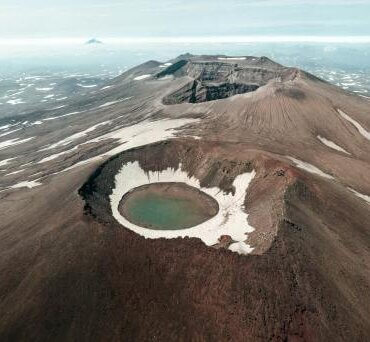
Gorely Volcano with Water on Crater. Kamchatka Krai, Russia.
Lava domes are fascinating things. In short, they are when a volcano builds a small, unstable, dangerous mountain, that will likely collapse at some point (or many). When lava reaches the surface at a near-solid or solid state, with much of the gases released as it rose through the crust, it can build vertically at the surface and form a large rocky mound, or a dome.

Janine Krippner
When a lava dome is growing, we call this an effusive eruption. These are more evolved magmas than the runnier (lower-viscosity) lava flows we see in videos out of Iceland or Hawaii, but like the majority of those eruptions, they are not explosive. Explosive means that the magma or lava is being blasted apart by violently expanding gases to form volcanic ash and rock chunks. This can form an ash plume or pyroclastic flow.
Lava domes can grow from pushing more lava up from the inside, or lava accumulating on the outside. Both scenarios mean that near-solid to solid rock is squeezing through the dome. There will be shaking associated with this, and volcanic gases moving through the system that may cause alteration. This all makes for an unstable situation.
To add to it, the lava dome could form on a steep surface, or grow to overtop a crater. They can also reach hundreds of metres in height. After the major eruption of Mount St Helens on May 18, 1980, the eruption period didn’t actually end there. A dome grew within the new crater, reaching around 300m above the crater floor. For reference, the Sky Tower in Auckland is 328 m.
If you were to watch a lava dome grow it might not look like anything much was happening. You might see a few rockfalls that kick up dust, and if you were there at night you would see the glow of hot rock. Occasionally you might see a small ash plume.

Purple Sky over Mountains. Kamchatka Krai, Russia. Photo: Anna Shvets, pexels.com
But something else can happen. With all this instability, huge chunks can collapse. When this happens, a block-and-ash flow forms, which is a type of pyroclastic flow with a high portion of solid rock bits with many easily exceeding the size of a car. Additionally, the breaking down of hot rock as it hurtles down the slope releases hot volcanic gases.
These flows can destroy everything in their path and bury the landscape in metres of rock, reaching kilometres from the volcano. The deposits I studied for my PhD at Shiveluch volcano in Kamchatka, Russia, reached 19km from the dome.
This process can also trigger an explosive eruption, releasing an ash plume high into the atmosphere.
This is an example of how a volcanic eruption might not always look like one. While it may appear peaceful, the situation can turn violent in an instant.
It’s yet another reason why I have a very healthy respect for volcanoes, and why keeping a good distance can be the best option.

Gorely Volcano with Water on Crater. Kamchatka Krai, Russia. Photo: Oleg Mikhailenko, pexels.com