


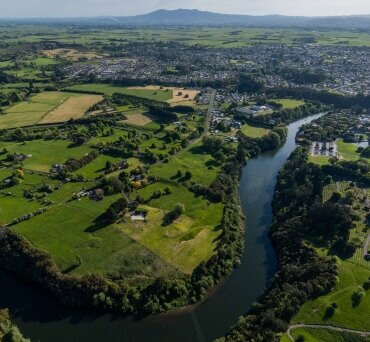
Waikato River
A significant part of Waikato Regional Council’s catchment management programme involves helping landowners/managers to better manage erosion prone catchments, particularly in the steeper parts of the region.
Loss of productive land in NZ hill country is estimated to cost our economy $100 to $150 million / year. The benefits include keeping soil on the hills where it is supposed to be, and reducing sediment loss and contamination into our freshwater bodies. The Waikato Hill Country erosion programme is a partnership between the Ministry of Primary Industries (MPI) and regional councils.

Stu Kneebone
The Waikato programme involves a targeted approach in catchments with the greatest erosion risks, and aims to support landowners with a suite of mitigations, including poplar pole planting, native afforestation and land retirement and reversion to native.
For those in the Karapiro Stream and upper Mangaonua Stream catchments (Whitehall and Te Miro) you may be eligible for up to 70% of the cost of fencing and planting.
A total of $745,000 is available from the programme over the next 4 years for these 2 catchments. Contact Melinda Dresser 078590858 or [email protected]
In the Waipa Catchment, the Waikato River Authority and regional council with the support of the MPI Hill Country Erosion Fund can work together to jointly support landowners via the Waipa Catchment Plan programme with a total of $4.15million available over the next four years.
The types of work eligible include fencing to retire steep, erosion prone land (including land with native bush on it), re-vegetation of steep, erosion prone land with natives, and poplar pole planting for stabilising land slips etc. Landowners in the Kaniwhaniwha, Moakurarua, Mangarama, Mangatea, Mangarapa, Upper Waitomo and Upper Puniu catchments may be eligible for funding assistance. Up until June 2024 (the next 2 months) up to 85% of the cost of work is able to be provided. However from July 2024 through to June 2028, 70% funding assistance will be available. Phone 0800 800 401 and ask for a catchment officer for your area.
The ability of the Waikato River Authority, MPI and the regional council to combine resources and assist landowners to undertake restoration work in steep, erodible and unproductive catchments provides a great opportunity to progress with future proofing your farming system.
For those with marginal steep gullies and other unproductive areas that are not really suitable for cattle, this funding assistance is worth considering. Noting that the pending Plan Change 1 regulations will require exclusion of cattle from certain streams and other waterbodies, this funding assistance will not be available for work required by regulation.
However in situations where landowners are prepared to go the extra mile and go over and above the regulatory bottom lines, demonstrate real value add for the health of a catchment, and for example create a wider riparian buffer than the regulations require, then this funding assistance can be applied. As well as mitigating erosion risk, this work also provides a range of other benefits to help future proof farming systems in hill country, including building resilience to climate change and enhancing native biodiversity.

The Waikato River. Image: Thajsko licensed under Creative Commons