

Pirongia Mountain

Janine Krippner
During my time working for the Smithsonian Institution Global Volcanism Program part of my job was gathering satellite images of volcanoes around the world and describing what they show. Looking at thousands of volcanoes during my time there, something that struck me was just how often large chunks of volcanoes fall down. This is speaking in geological timescales, not our comparatively very short human lifetimes.
When a large part of a volcano collapses, we call this flank collapse. This is usually made up of a mix of layers of loose debris (volcanic ash, ballistic ejecta or rocks that are thrown out during eruptions, lahar (volcanic mudflow) deposits, and pyroclastic flow deposits), solid lava flows, domes, and magmatic intrusions that didn’t reach the surface, plus water and maybe ice. Some of this might be hydrothermally altered, which can turn glass and minerals that make up the rocks into more of a slippery clay that can be very unstable. Flank collapse can be triggered by volcanic activity, like at Mount St. Helens on May 18, 1980, when magma rising up into the volcano pushed out the north flank and eventually this failed, or during times when there is no volcanic activity. If magma is ready, this can trigger an eruption. Either way, the result is catastrophic for the landscape.
The three most scary thing about these processes in my mind are 1) they can happen when the volcano is otherwise quiet, so with little or no warning, especially if we aren’t watching closely, 2) they can be enormous, travelling many kilometres from the volcano and emplacing thick debris avalanche deposits over vast areas, and 3) they can move very fast.
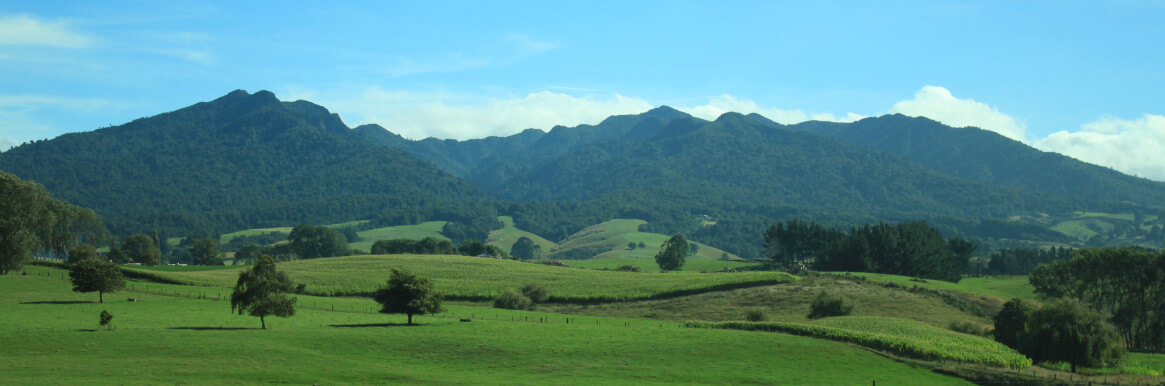
The rock is what we call very mobile – it can move much faster than we can run and travel great distances, with the rock breaking down into smaller chunks as the whole mass races along the landscape. When it stops moving and settles on top of the landscape, we call it a debris avalanche deposit. At Mount Shasta in California, an old debris avalanche deposit covers an area of around 675 square kilometres – travelling at least 45 km from the volcano. Large chunks of the mountain can stay intact as it moves to form what we call hummocks that stick out of the landscape. You can do a short walk around these on the way to Ruapehu when travelling from the north, you can also see them around Taranaki. Oliver McLeod recently found a 3.3 square kilometre debris avalanche deposit at Pirongia that reaches more than 20 km from where it began. They have contributed to shaping our beautiful landscape.
Thankfully for us, these are relatively rare in our lifetimes. We do take them seriously though, studying the deposits of past events so we understand how they moved and what triggered them, using computer models to see what areas could be impacted in the future, and looking at the stability of volcanoes to see which areas might be more at risk. Volcanoes are a critical part of our landscapes and our planet. This is one more of those processes that we need to understand and respect so that we can get out of the way, then begin to recover once it has stopped.