


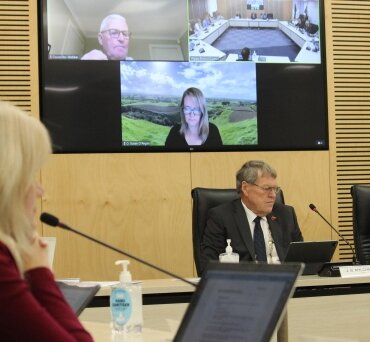

Waipa District Council meets to discuss supporting private members bill.
Two Waipā district councillors have broken ranks saying they are unconvinced banning alcohol sponsorship and advertising under proposed law changes to the liquor act will have any impact on youth use.
-

- Roger Gordon
-

- Grahame Webber
Roger Gordon and Grahame Webber were the only two councillors to vote against endorsing Green Party member Chlöe Swarbrick’s private members’ bill.
That bill proposes winding down alcohol advertising and sponsorship.
Waikato DHB medical officer of health Richard Hoskins supports it and told the council local government had a “significant responsibility” for the wellbeing of its communities and so it was appropriate for Waipā to advocate for liquor act changes.
Swarbrick’s bill also seeks to remove a special appeal process in place on local alcohol policies.
Hoskins said local authorities like Waipā had been “thwarted” by unnecessary appeals on its local policies in the past.
Gordon said he was aware there was a culture of alcohol abuse among youth.
“I come from a family that’s got a real history in sport. I’ve got children who are New Zealand representatives and I have grandchildren who were New Zealand representatives,” he said.
“But in fact, I don’t see the fact there is an alcohol billboard around the side of the ground has affected any of my kids in either playing the sport or consuming the alcohol.
“I think the alcohol is a social phenomenon and I’m unsure whether how much that billboarding or support is affecting that and yet the money they pour into the support of all sport, enables more people to participate more readily in what is really a welcome activity throughout all ages.”
Webber said he was struggling with agreeing to winding down alcohol sponsorship in the face of reports about the impact of fast food advertising.
-

- Andrew Brown
-

- Mike Pettit
Councillors Andrew Brown and Mike Pettit disagreed.
“These (alcohol) people don’t put the placards and things up because it doesn’t work,” said Brown.
“It does help sell alcohol and sell it to people who struggle to cope with the impacts of it.”
Pettit said alcohol companies did not support something unless there was money in it for them and their shareholders.
Alcohol advertising and the exposure to it was primarily aimed at males, he said.
He wondered how women’s sporting teams like the Silver Ferns had managed to get sponsorship from non-alcohol companies while the All Blacks’ sponsorship relied on beer brands.
“How come women’s sports can actually find other ways of getting sponsorship and getting traction and how come rugby is heavily focussed on alcohol advertising to survive?”

Susan O’Regan
Councillor Susan O’Regan said there was evidence about the impact placement of billboards and advertising alcohol has on drinking intensity and accessibility.
“It seems to me the data is pretty clear around sponsorship and advertising.”
Mayor Jim Mylchreest said alcohol did “huge harm” to the nation.
“The family harm through excessive alcohol use is horrendous in our health statistics and our social welfare statistics.”
A number of other councils, including Whanganui, Christchurch, Auckland, Hamilton and Hauraki have already endorsed the proposed law change.
Gordon was also reluctant to see the appeal process for local alcohol policies taken away saying the community needed to have an effective voice.
“I suggest if there was an appeal it would be brought forward in relation to the licensing regulations, the voice of reason would outweigh the vice of those against.”

Jim Mylchreest
In his report to the council, Compliance manager Karl Tutty said the council had spent “a considerable amount of time and money” using legal advice to mediate concerns about its Local Alcohol Policy. Other councils had abandoned their policies, he said.
“While the focus of this Bill is on appeals by well-funded commercial operators, removing all appeal provisions would also curtail any ability for police, medical officers of health, inspectors, community groups or the public to raise concerns.”
Appeals had previously cost councils hundreds of thousands of dollars and tied up locally-driven alcohol policies for years.
Mylchreest said removing the appeal process would not inhibit the community at all.
“It stops the games being played by those national supermarket chains and liquor sales businesses that use it for anti-competitive issues rather than public health.”

Marcus Gower
Council delegated councillor Marcus Gower to advocate to central government in support of the proposed bill. If the bill is successful in being introduced to Parliament, council would have an opportunity to submit through the Select Committee process.