


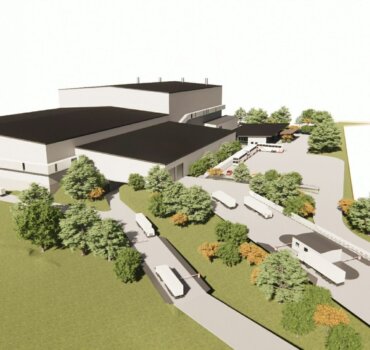
An artist’s impression of how the site might look.

Project director Adam Fletcher and CEO Roger Wilson – Photo Benjamin Wilson
Waipā homes could be powered by New Zealand’s first waste-to-energy plant.
The plants take in rubbish, sort and recycle it, and then combust what cannot be recycled to power steam turbines. While waste-to-energy plants are used internationally, this plant will be New Zealand’s first.
Vienna’s Pfaffenau Waste Incineration Plant in Simmering opened in 2008 and has converted 250,000 tonnes of waste into energy annually.
Global Contracting Solutions Limited is going through a resource consent process for the plant, which is called Paewira Recycle Plant and is designated for 401 Racecourse Road, Te Awamutu.
The innovative project includes features such as a cafeteria, a visitor education centre, e-bike charging stations, and a full walkway around the plant with feature windows.
The idea for the plant originated from Global Metal Solutions Limited, a New Zealand based metal recycling company. They recycle products such as cars and refrigerators but are left with materials that they currently cannot process.
“We end up with things like rubber, plastics, carpet, vinyl and foam that we can’t do anything with. We thought, what can we do with those? At the moment, they all go to landfill because there is no alternative use for them,” said Global Metal Solutions (GMS) CEO, Roger Wilson.
Paewira is designed to process 150,000 tonnes of waste derived fuel annually, with 20% of that waste (30,000 tonnes) already accounted for from GMS’s pre-existing recycling facilities. From those 150,000 tonnes, the plant could produce 15 megawatts of power, which is enough to power 15,000 homes, or all of Te Awamutu, in the summer.
High temperature combustions in conjunction with filtering and scrubbing processes, leave the flue gas relatively clean.
“Everything that could be regarded as nasty would be filtered, so there wouldn’t be a visible plume,” said the project’s director, Adam Fletcher.
Fletcher said steam would only be visible if the ambient conditions allowed for it, such as cold weather.

An artist’s impression of how the site might look.
The team acknowledged that while Paewira would produce carbon dioxide, methane, which is a more harmful greenhouse gas, would not be produced.
“Last year’s COP26 summit in Scotland was about methane. And in New Zealand, methane comes from landfills and cows,” Fletcher said.
The materials that would remain after the combustion process could be filtered and further recycled. For example, steel wire leftover from burning a tyre could be gathered and then reused. There is also the potential of third parties repurposing the remaining ash to create cement or bricks.
As GMS is a predominantly Māori owned business, choosing land that has a whakapapa connection was of importance for Paewira’s location. Te Awamutu’s Ngāti Apakura have been consulted with and are supportive of their venture. They are hoping to collaborate with Ngāti Apakura to share and teach visitors of the land’s history and whakapapa, such as the battle fought at Ngaroto. They also want to teach people about recycling and offer educational tours around the plant.
Fletcher said because the land is industrial zoned, their sound production is unlikely to exceed the pre-existing ambient levels. Most of their sound is said to come from trucks instead of the recycling facility itself.
Paewira will use water from the domestic supply and will not take or add water to the Mangapiko Stream. Their wastewater will be sent via trucks to third party treatment facilities to process.