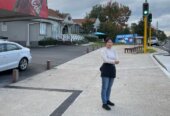



Ute and caravan blocking visibility at off-street car park exit and parking on damaged berm and footpath
A truckie stop on Leamington’s Cook Street has created a problem for Waipā District Council and after months of consultation and debate resulted in the loss of most on-road parking.
There are health and safety concerns coupled with considerable damage to footpaths and berms – and as a result only three parking spaces will remain on the portion of the street between the Victoria (high-level) Bridge and Shakespeare Road roundabouts.
But council transportation safety officer Julie Taylor told Service Delivery committee members it was only a matter of time before those three spaces go as well and businesses would have to prepare for that.
Cook Street has become a major arterial route through Cambridge for vehicles which are not suitable for the high-level bridge.
About 10,000 vehicles a day, including 1200 trucks, travel along the road. Committee chair Grahame Webber said one of the most popular stops, particularly for truckies, is Cafe 9.
While the cafe has customer off-street parking at the rear of its premises, those space are unsuitable for trucks.
Adding to the problem, vehicles parked all day in a council-owned car park opposite Cafe 9, Ms Taylor said in her report.
The existing shoulder parking on Cook Street was too narrow and it made parking unsafe and as a consequence more vehicles were parked partly on the berms and footpaths to keep out of the traffic flow.

Damage to berm and debris on footpath on Cook Street
She said because Cook Street was a designated major arterial route, traffic movement function took precedence over property access and parking.
Cambridge Community Board members have twice debated the issue of whether to remove on-street parking, deputy mayor Liz Stolwyk said.
“Doing nothing is not an option. It is a safety issue.”
Ms Stolwyk said she considered part of Cook Street, which included Cafe 9 and other retailers, was part of Cambridge’s central business district.
It was popular with cyclists as a transitioning stop, she said.
Ms Taylor said a recommendation to remove on-street parking supported the efficient movement of traffic and freight within Waipā District and the economy as it recovered from the effects of Covid-19 restrictions.
The committee opted to approve 120-minute parking restrictions to prevent all-day parkers. Parking could continue in nearby Burns Street.
A 120-minute time limit would remain for the three remaining on-street parks to maintain regular turnover of vehicles.