

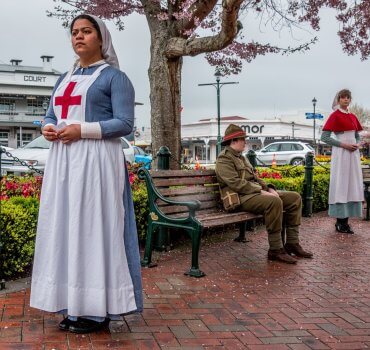

Year 13 drama students from Morrinsville College walked the streets of Cambridge dressed as the New Zealand soldiers and nurses that died during the Battle of Passchendaele. Photo – Michael Jeans.
There was a solemn silence in the Cambridge CBD on Thursday morning when the ‘ghosts’ of fallen soldiers stood on the street in remembrance.
They were year 13 drama students from Morrinsville College, dressed as the New Zealand soldiers and nurses that died during the Battle of Passchendaele in Belgium, 1917.
October 12th marks 100 years since one of our country’s darkest days – the most devastating battle in our military history, when 842 New Zealanders were killed in just four hours of battle at Passchendaele.

The students finished their performance at the Cambridge Cenotaph. Photo – Sophie Iremonger.
A failed attack by British and Australian troops was supposed to open the way for NZ soldiers to attack Germans occupants at the Passchendaele village. The Kiwis pushed forward anyway and were pinned down by German machine guns in thick mud, resulting in our worst-ever war toll. The survivors eventually fell back to the start position and were later helped by Canadian troops to take the village.
“We are the ghosts of the past, here to remind you not to forget the sacrifices of the few for the many,” read the cards that the students gave to curious passers-by on Victoria Street. As ‘ghosts’, they remained silent throughout; the only sound heard from them was when one girl sang the iconic Pokarekare Ana – a love song written around the start of World War One.
“It’s not every day you see people dressed in the World War One era walking through the town,” said their teacher Louise Keenan, head of drama at Morrinsville College. “Everyone sort of knows about Gallipoli, but this (Passchendaele) was actually New Zealand’s biggest battle, and nobody really knows about it, it’s New Zealand’s darkest day.
UK artist Jeremy Deller came up with the idea of doing this for the Battle of Somme centenary last year, Louise said. “It’s based on the idea that after the Great War, lots of people reported seeing their dead relatives in the shopping centres and train stations and that, so it’s that idea of their ghosts being among us. A few people have been saying that it gives them the chills a little bit, seeing this.”
The contingent of students dressed as soldiers and nurses walked from Duke Street along Victoria Street to the cenotaph, stopping along the way to stand silently in remembrance.
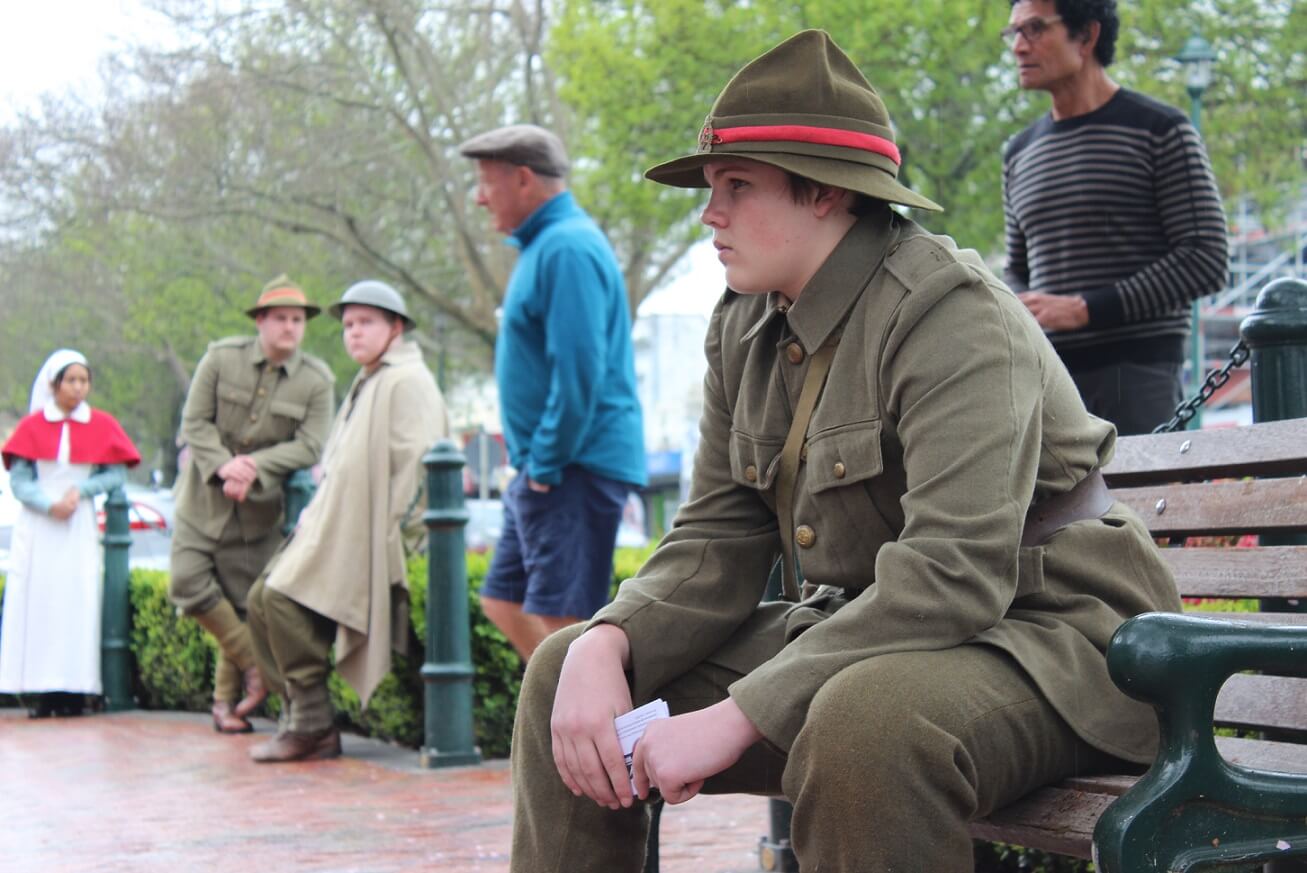 They went on to do the street performance in Te Awamutu and Hamilton, having done the same in Matamata earlier that day.
“We wanted to recognise the fact that as lot of these people (killed in the battle) came from rural New Zealand, it wasn’t just Auckland, Wellington and Christchurch,” Louise Keenan said.